Why you can trust our answers
The AI does the talking. Your data does the numbers.
Language models are fluent, and fluent isn’t the same as right. So in Slipstream the model never produces a figure. Recipes compute every number from your synced data, in steps you can open. The model’s job is to find the right ones and explain them, and a plain check turns away any answer that strays.
- Bookingssynced data
- Open nightsin 1 recipe
- Any findings?in 5 recipes
- Airbnb guest checks out Tuesday
- Next 2 nights open, usually $200 a night
Send the offer through your PMS the evening before check-out.
- 29 recipes
- in the catalogue today, each one open on the canvas
- 43 parts
- that every one of them is built from
- 9 call an LLM
- to read reviews or check an assumption against published evidence, each a visible step
- 1 part, 12 recipes
- one revenue calculation, read by every recipe that needs it
Slipstream builds on calculations you can trace, not an AI black box
We built Slipstream to rely on auditable calculations, not black-box AI queries that can hallucinate, change over time, or simply answer you with a mistake. Slipstream guards against these common pitfalls, and you can test every one of them in our demo.
- “AI makes up numbers”
- Ask never types a figure. It names a value a recipe or query returned, and Slipstream puts the figure in, with a link to where it came from.
- “AI gets the arithmetic wrong”
- Totals, gaps and comparisons go through a calculation step that shows its formula and inputs, never through the model's own sums.
- “AI invents reasons”
- Ask may say “because” only when it has read a recipe that states that cause. Otherwise it reports what happened, not why.
- “AI sounds sure when it's wrong”
- A plain, rule-based check reads every answer before you do. One that fails is rewritten once; if it fails again you get a plain list of what was found, labelled as such.
- “AI answers anyway”
- When nothing in your account measures what you asked, Ask says so and names the nearest thing it can show.
- “AI works from old data”
- Every answer starts by reading when each source last synced, and “How we computed this” shows it.
- “AI acts on its own”
- Ask reads; it never sends or changes anything. Nothing reaches a guest or an owner until you decide.
We measure it, misses included
We test Ask on 60 questions hosts ask, against a working host’s account, graded by a separate model. In the latest run 54 answers were right, 2 were right with a minor flaw, and 4 were wrong. No system that talks is perfect, which is why every figure carries its link: you can check any answer in one click, and the steps behind it are open in Framer.
Why parts scaffold and patches don’t
Most software answers a new request with a new feature: its own code, its own screen, its own upkeep. Each one works, and together they don’t add up. Framer answers with an arrangement of parts the system already has, so every recipe makes the next one cheaper to build and easier to trust.
A new recipe reuses what's already proven
You can try out your ideas by dragging and dropping parts. In many cases the rules and the verdicts they rely on are already built, and already checked and working in other recipes.
Change it once, and it's changed everywhere
One part works out each property's monthly revenue and upcoming bookings, and 12 recipes read it. A change to that part reaches all 12, instead of being made 12 times and drifting apart.
A language model is a step, not the system
9 recipes include a step that asks a language model: reading reviews, pulling amenities from listing text, or checking an assumption against published evidence, with citations. It sits in the chain like any other part, its input and output on the canvas. The model is a setting, two can be compared side by side, and the arithmetic around it stays plain enough to read. One errant email or text from an unattended bot can do real damage, so a person is always the last step: recipes recommend, and nothing reaches a guest or an owner until you decide.
Yours, and stable
Recipes live in your account, not in our code. Shipping a new version of Slipstream never silently changes what your numbers mean, and any recipe can be opened, tuned or built on.
| Question | A one-off feature | A recipe from parts |
|---|---|---|
| Built from | Code written for one request | Parts other recipes already use |
| How it works | Inside the product, out of sight | On the canvas, step by step |
| When it reads wrong | Wait for a release | Trace it to the step, and change that step |
| Upkeep | Each one maintained on its own | A change to a part reaches every recipe using it |
| Where it shows | Wherever it was built | Docked on your dashboard, shared with owners recipe by recipe |
Every recipe on the board
The whole catalogue, and what each recipe catches in a working portfolio. Read down the “built from” column and the same parts keep coming back. Those marked asked for by hosts answer something hosts asked for in public, or built by hand, before it was a recipe.
- OCT 2026
Fee GapsAsked for by hosts
A stay recorded without the cleaning fee the property's other bookings on that channel carry.
- Fee gaps
- Any findings?
- OCT 2026
Overlapping Bookings
One booking stored twice, its revenue counted twice, or a real double booking.
- Shared nights
- Any findings?
- OCT 2026
Open NightsAsked for by hosts
A guest checks out Tuesday and Wednesday night is empty: offer it to them before they leave.
- Open nights
- Any findings?
- Booking economics
- If / then
- SEP 2026
Momentum vs. Pace
Growth from last year that isn't showing up in next quarter's bookings.
- Booking economics
- Then vs now
- Formula
- If / then
- SEP 2026
Lead-Time Drift
Guests booking closer to arrival than they used to, flagged when they cross the 30-day line.
- Booking economics
- Time window
- Trend
- Formula
- Safe ratio
- If / then
- Enough data?
- SEP 2026
Reversal Watch
The last four months disagree with the twelve-month trend: a turn, caught early.
- Booking economics
- Then vs now
- Time window
- Trend
- Formula
- Enough data?
- If / then
- JUL 2026
Momentum Monitor
Twelve months against the twelve before: gaining or losing steam, and whether to fix the stay or the price.
- Booking economics
- Review pulse
- Rank in portfolio
- Then vs now
- Time window
- Trend
- Formula
- If / then
- Pick a value
- Evidence check (asks a language model)
- JUL 2026
Booking Pace Sentinel
Is the next 90 days booking as well as the same dates were at this point last year?
- Booking economics
- Formula
- Bands
- Pick a value
- Evidence check (asks a language model)
- APR 2026
Pricing Oracle
Your nightly rate against comparable listings adjusted for size and amenities, in dollars a night.
- Price vs comparables
- OCT 2026
Reviews OwedAsked for by hosts
Guests who left 3 to 14 days ago without a review: the list to chase while the window is open.
- Reviews owed
- Any findings?
- OCT 2026
Review RateAsked for by hosts
Which stays get reviewed, split by stay length, season and channel, against your whole account.
- Review rate
- Filter rows
- Count and sum
- If / then
- APR 2026
Review Signals
What guests keep mentioning across every review, read by a language model and grouped into themes.
- Review scan (asks a language model)
- Prompt tuning (asks a language model)
- First that exists
- Group into themes (asks a language model)
- APR 2026
SignalWeaver
Reads review signals across 14 categories and proposes new questions worth building a recipe for.
- Review scan (asks a language model)
- Hypotheses (asks a language model)
- OCT 2026
Upkeep Cost per Guest-Night
Septic, water and propane bills on your statements, per guest-night: what each person who stays costs to keep the house running.
- Cost per guest-night
- OCT 2026
Guest Load
Septic, water, propane and laundry follow people, not nights: how many stayed, and whether it's more than last year.
- Guests by month
- ledger series
- Then vs now
- Formula
- Booking economics
- Filter rows
- Count and sum
- If / then
- JUN 2026
Upgrade Strategist
The improvement guests' complaints point to, sized against what the property really earns.
- Review scan (asks a language model)
- Booking economics
- Lookup table
- Formula
- Evidence check (asks a language model)
- MAY 2026
Maintenance Dispatch
Maintenance risk weighted by revenue and upcoming bookings, as a work list in the order to send people.
- Upkeep risk
- Booking economics
- Formula
- Owner signals
- Evidence check (asks a language model)
- APR 2026
Maintenance Prophet
Review sentiment sliding at an older home: upkeep flagged before something fails.
- First that exists
- Formula
- Review scan (asks a language model)
- Keyword match
- Language model (asks a language model)
- Weighted score
- Recent counts more
- Review pulse
- Then vs now
- If / then
- Evidence check (asks a language model)
- SEP 2026
Owner Pulse
Unanswered owner questions, new charges, soft pace: early signs an owner may leave, each with the action that answers it.
- Owner signals
- Booking economics
- Upkeep risk
- Formula
- Bands
- If / then
- SEP 2026
Owner Market Brief
The numbers owner and co-host both read: price against comparables, the next 90 days booked, and pace.
- Owner signals
- Booking economics
- Formula
- MAY 2026
Owner-Churn Risk
Earning less than similar homes, rising upkeep risk and a fading retention signal, averaged: owners at risk of pulling the listing.
- Price vs comparables
- Upkeep risk
- Repeat intent
- Owner context
- Rank in portfolio
- Formula
- First that exists
- If / then
- MAY 2026
Value Scorecard
The value you deliver each owner: rate premium over your similar homes, revenue and upkeep, to stand behind your fee.
- Price vs comparables
- Upkeep risk
- Host responsiveness
- Booking economics
- Formula
- Safe ratio
- If / then
- SEP 2026
PMS ↔ Statement ReconciliationAsked for by hosts
Bookings on the statement but not in the PMS, or the other way round, and rent the two disagree on.
- Bookings as a ledger
- Match two ledgers
- Any findings?
- SEP 2026
Statement Recurring-Charge Check
A kind of charge that is new on this statement, or one that has stopped.
- What changed
- Filter rows
- Count and sum
- If / then
- SEP 2026
Statement Fee-Base Derivation
What the management fee is really a percentage of: rent, rent plus cleaning, or rent after the channel's cut.
- Find the fee base
- If / then
- AUG 2026
Website Listing Audit
Is the home on your own website, and do its bedrooms, baths, guests and location still match the PMS?
- Is it there?
- Do sources agree?
- Lookup table
- Read a number
- Formula
- If / then
- Compare text
- APR 2026
Amenity Extraction
Reads listing text for amenities the PMS never recorded, with two models checking each other.
- Keyword match
- Two models compared (asks a language model)
- First that exists
- MAY 2026
Attention Queue
Every property's open issues, put on one scale and ranked into a single queue for the portfolio.
- Upkeep risk
- Price vs comparables
- Marketing gaps
- Formula
- Evidence check (asks a language model)
- APR 2026
Portfolio Orchestrator
Where a home ranks, the gap to your top earners, and the amenities they have that it lacks.
- Portfolio context
- Formula
- Evidence check (asks a language model)
Open any of them
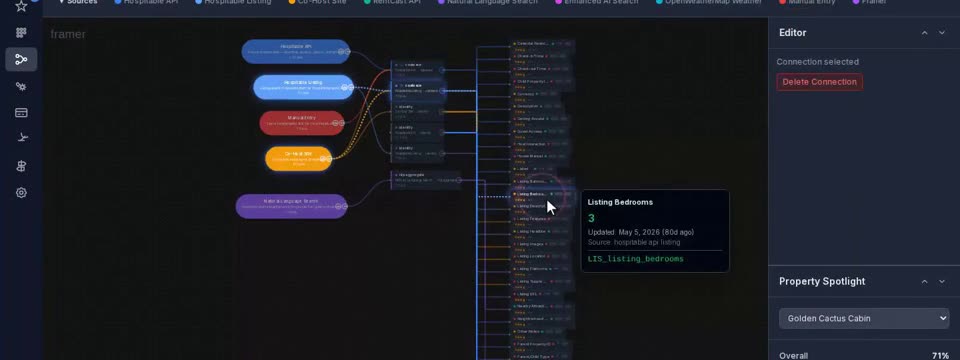
See it
Every figure traces back through the graph to the raw field it came from. Follow it node by node until you hit the source record.
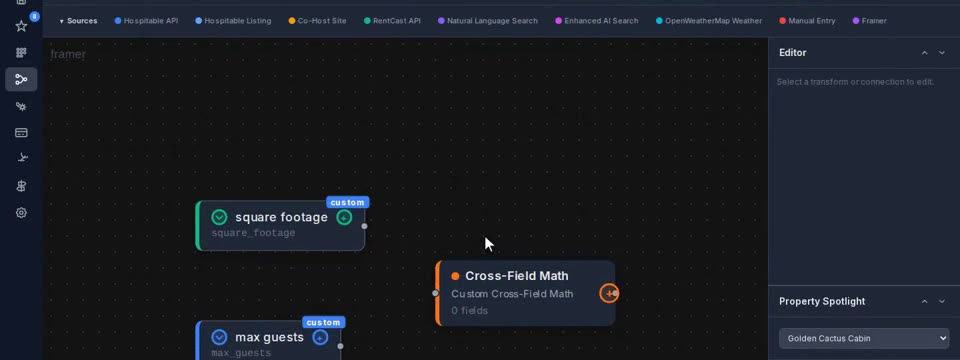
Tune it
The logic is yours to change. Thresholds, weights, wording, which sources win a conflict — edited by the operator, without code.
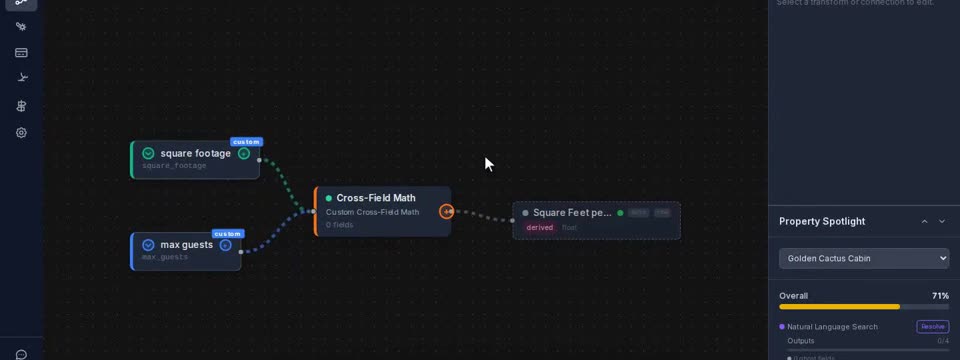
Build it
Assemble entirely new tools from your own raw data. Not chosen from our menu, not requested from our roadmap.