Rental Portfolios
 Hospitable
 OwnerRez
Know what needs a decision today.
What’s slipping, what’s working, what to do next.Connect your PMS, and we do the rest: a live read on every property, your reviews turned into a repair roadmap, every listing detail checked against property records and your website, and a portal that answers owners’ questions before they have to ask. Every finding shows its reasoning, built from recipes that are yours to use, remix or write from scratch.
- overlap: A Vrbo booking also entered by hand: same guest, same dates, $986 counted twice.
- open night: An Airbnb guest checks out Tuesday; the next 2 nights are open, usually $200 a night.
- fee gap: No cleaning fee on one Airbnb stay, though 63 of the 65 others carry it: usually $260.
- goal: Cabin 7’s review rate is 71% against your 80% target: 6 reviews short.
- reviews: Three stays mention a broken blind: here’s the window, with a fix sketched on it.
- record: Listing says 4 bedrooms; county record says 3.
- owners: Smith stay: refund, payout and AirCover in one incident, net +$155, ready before the owner asks.
- goal met: Lakeside booked 26 nights in November against a target of 24.
What’s your portfolio leaving on the table?
Bookings exposure / yr
$36,823
$31.54/night below market
Upgrade revenue upside / yr
$75,024
recoverable by fixing each property’s top guest-review friction point
These numbers come from Slipstream recipes.
Based on 10–11 representative properties across portfolios we actively track, updated 2026-09-17, not a computation of your own properties.
No PMS account needed to look around. One login works for the demo and the real thing.
Rent out your own place on Airbnb? See what your listing is leaving on the table →
Co-host or manage for owners
Other tools give you opinions; we ground ours in reality. Every number shows its reasoning.
Rent out your own place on Airbnb
Your price against similar homes nearby, what guests keep mentioning, and which fix is worth the most. Just connect your Airbnb account (free, through Hospitable Connect). 14‑day trial.
Build your own owner statements
See how each statement adds up, line by line. Free, with no account.
What Slipstream does for you
Findings that check themselves
Other tools tell you what they think; Slipstream also checks them against reality. Each metric is graded on whether it actually tells your properties apart, its assumptions are checked against published evidence, and past recommendations are scored against what really happened.
Your listing against the record
Slipstream compares the same fact across your PMS listing, your own website and property records, and flags where they disagree: “Listing says 4 bedrooms; county record says 3.”
Reviews to repairs
Slipstream reads every review for problems that come up across stays. It can find the listing photo that shows what guests are describing and propose fixes, from a quick repair to a replacement, drawn right on that photo.
Owner trust, early
An owner asks about a specific finding from their dashboard, not in a crowded Slack thread, and both sides see when it's resolved. Damage refunds, AirCover reimbursements and large repairs are gathered into one incident, with the net amount, before the owner asks. Early signs that an owner may leave are brought together while there's time to act.
What’s your portfolio leaving on the table?
Enter your property count. The dollar estimates come from Pricing Oracle and The Upgrade Strategist, run against properties we actively track.
Estimated bookings exposure / year
$36,823
from listings priced a median $31.54/night below market
Upgrade revenue upside / year
$75,024
recoverable by fixing each property’s top guest-review friction point
These numbers come from Slipstream recipes.
Based on 10–11 representative properties across portfolios we actively track, updated 2026-09-17, not a computation of your own properties.
Why Slipstream?
We provide the answers you need to run a rental portfolio, built from data recipes that are yours to use, remix or invent from scratch. When an owner asks about a booking, recipes generate instant answers that put the same numbers in front of you both, before the question can be lost in a Slack thread.
Pricing & revenue
For co-hosts
See which homes earn below comparable listings, and by how much a night. Catch a slowdown before the yearly numbers show it: growth that isn't booking next quarter, a recent turn, guests booking closer to arrival. Spot the open nights after a check-out, with what they usually fetch, and the stay missing a fee its others carry.
For owners
The same pricing and booking pace you see, so a soft month reads as the market, not the manager.
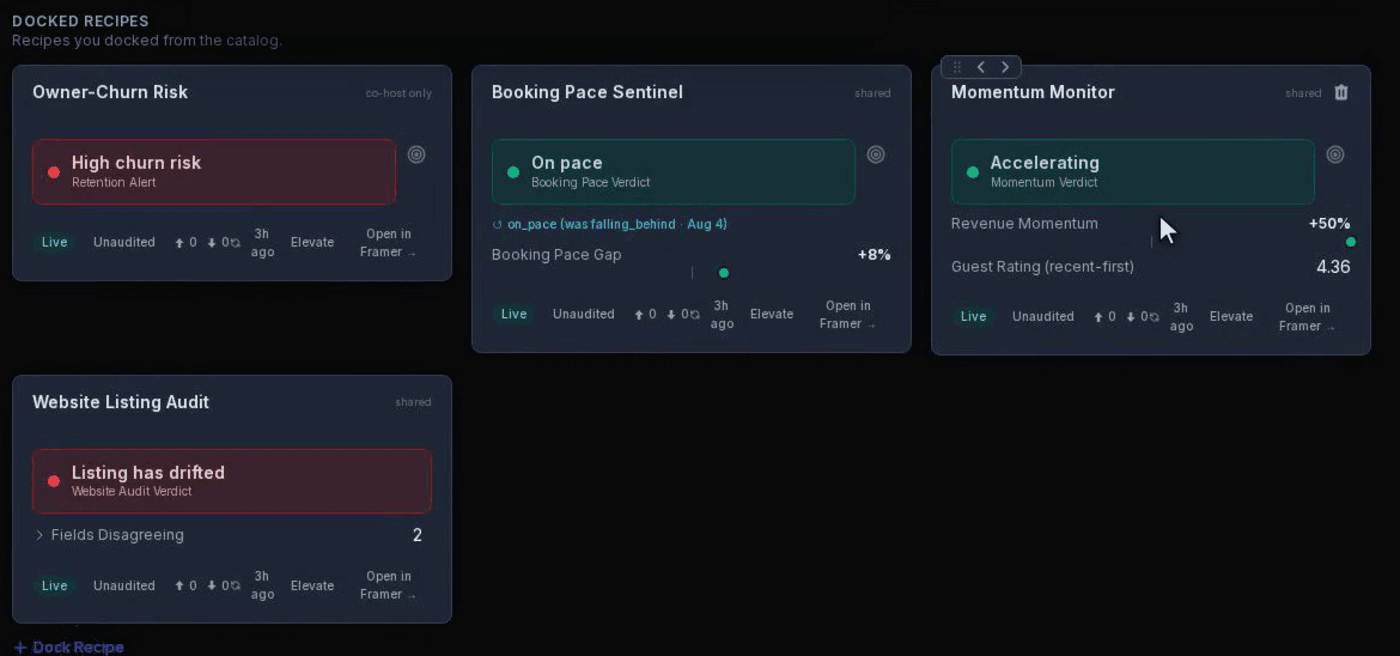
Pricing Oracle · Booking Pace Sentinel · Momentum Monitor · Momentum vs. Pace · Reversal Watch · Lead-Time Drift · Open Nights · Fee Gaps · Owner Market Brief
Priorities across the portfolio
For co-hosts
One ranked list showing what to pay attention to first. See where each home ranks on revenue, the dollar gap to your top earners, and any amenity gaps compared to others. Behind that, a payouts chart marks actions you took so you can see the results since.
Top Priorities · Portfolio Orchestrator
Owner relationships
For co-hosts
Poor communication is the #1 reason owners switch managers.1 Refunds and damage recoveries are caught as each booking syncs and stay open until closed, and an owner’s question about a booking opens with an automatic response. Unanswered questions, rising costs and a soft calendar are flagged months early. Show owners the value you delivered against your fee.
For owners
Send your co-host a note or flag a booking from inside Slipstream, and see when it's resolved.
Owner Pulse · Co-Host Value Scorecard · Notes · Incidents
Reviews & listing quality
For co-hosts
What guests actually complain about, in their own words, and which fix is worth the most revenue. Your own website's listings checked against your PMS, field by field. Which guests still owe a review, and your review rate by stay length, season and channel.
For owners
The upgrade case for your home, with the reviews behind it.
Upgrade Strategist · Review Signals · Review Rate · Reviews Owed · Website Listing Audit
Maintenance
For co-hosts
Which homes are heading for trouble, from age and what guests mention, and the work ranked by the revenue at stake, with the next stretch the home is empty long enough to do it.
For owners
Early notice of the repairs your home is likely to need.
Maintenance Prophet · Smart Dispatch
Owner statements
For co-hosts
Every statement line checked against your booking records, the fee base worked out from the statement itself, a charge that appears for the first time flagged before the owner asks, and a booking stored twice caught before its revenue is counted twice.
Check a statement with Reconify →
Reconify · Overlapping Bookings
Every recipe, what it catches, and the parts they share →
Set a target on any of these numbers and see how far off you are →
There are plenty of dashboards that give you readings.
- But are they right? Can you see where those results come from?
- Are they useful to you — or are they built around people with different needs?
- Can you see them, and tune them?
In Slipstream, nothing is a black box.
See it
Every figure traces back through the graph to the raw field it came from. Follow it node by node until you hit the source record.
Tune it
The logic is yours to change. Thresholds, weights, wording, which sources win a conflict — edited by the operator, without code.
Build it
Assemble entirely new tools from your own raw data. Not chosen from our menu, not requested from our roadmap.
A dashboard that only offers the first of those is a report. We think the reason you bought a reporting layer is that a report was not enough.
Every number opens up
Every reading above comes from a recipe, and every recipe is open. Open one and you see the data it started from, each step it took, and the thresholds it was judged against.
A recipe is a chain: sources, then transformations, then the number you actually read. You build and edit them in Framer, the visual graph editor — and they live in your account, not in our code. Shipping a new version of Slipstream never silently changes what your numbers mean.
How Framer builds every recipe from shared parts →
Anatomy of a recipe
Two sources feed a formula you write; the answer stays live and every step behind it stays open.
Goals
Set a target on any number, and see the gap
Do you track review rates on spreadsheets or compare your monthly totals to your projections? In Slipstream these are goals: a target on a number your recipes already measure. Review rate, rating, revenue by a date, nights booked, or any number from a recipe you’ve docked or built yourself.
Each goal reads in its own terms: reviews short, dollars to go, nights over. It shows which property is pulling the total down, and it shows up on your Live Line the day it’s met, slips, or comes within reach. Log a change you made, and Slipstream scores it on what came after.
- The target is yours. We show your own trailing number for reference, and never fill in the goal.
- The count is always shown. Below 10 stays, a rate reads “Too few” and claims nothing.
- No forecasts from rates. A total by a date shows what’s earned and what’s on the books.
Owner Pulse
Keep the owners you worked hard to win
Owners rarely leave without warning. The warnings are just scattered: a statement line nobody explained, a question in Slack or email that sat for a week, unexplained bills for breakage. Owner Pulse brings them together early enough to act. Our platform makes it easy for owners to send notes about findings right from the dashboard, rather than manually writing out questions on an already crowded Slack channel.
- Why owners switch managers
- #1: communication1
- 57% of owners who switched cite poor communication, and 43% expect a same-day reply.
- Replies come fast, or rarely
- 47 minutes2
- Half of all email replies arrive within 47 minutes, and nine in ten within a day. A question still waiting tomorrow is in the tail that rarely gets answered.
Same numbers, both sides
Owners and co-hosts can share one view of bookings, pricing against comparable listings and booking pace. When the season is slow, owners see what is already booked, not a guess.
Every question gets an answer
Owners can send you a note, or you can flag any booking and write about it. A note about a booking opens with an automatic response: the booking's revenue, fees and payout, and any refund or recovery on it, so you confirm instead of digging. Nothing gets lost, and both of you see it resolved. No owner accounts yet? Log their calls and emails as notes to yourself — Owner Pulse tracks those too.
No surprise costs
Guest refunds, resolution payouts and AirCover reimbursements are caught the moment a booking syncs and stay on your incidents list until closed. Rising supplies and repair costs per booked night, and any new kind of charge, are flagged from your uploaded statements before the owner finds them, so you can explain them first or agree on them together.
An honest plan for hard seasons
When rates and bookings both lag, you both see what is already booked and how the property prices against comparable listings, so you can decide together: reset pricing, hold through peak season, or plan a clean handoff.
For owners: clarity and a voice. For co-hosts: fewer surprise goodbyes.
- Buildium, 2026 Rental Owners' Survey (300 owners): poor communication is the top reason owners switch managers (57%), and 43% expect a same-day reply. Source
- Kooti et al., “Evolution of Conversations in the Age of Email Overload”, WWW 2015: 16 billion emails; half of replies within 47 minutes, over 90% within a day. Source
- HubSpot research, via Help Scout: 60% of customers define an “immediate” response as 10 minutes or less. Source
- Oldroyd, McElheran & Elkington, “The Short Life of Online Sales Leads”, Harvard Business Review, 2011: 2,241 firms; answered within an hour, a lead was nearly 7× likelier to be qualified. Source
We customise around the way you already work
Your operation is not a template, and the setup is not left to you.
We fit your website
Your co-host site is a data source, not a brochure. We build the adapter that reads yours, so your own published listing copy can be reconciled against what your PMS believes.
We find comps
MLS records, county data and valuations for the neighbourhoods you actually operate in — so a nightly rate can be argued from local fundamentals instead of instinct. You can open every step of it, change the comp set, or disagree with the adjustment.
We proof your recipes
Every recipe rests on assumptions. We check them against the open web and tell you which held, which needed refining, and which the evidence contradicts.
Real people
Support from real people, who can help you tune your portfolio specifically. Our built-in messages and requests make it easy to reach a human, not a bot.
Your owners can get the numbers that matter to them
Owners see performance, maintenance trends and guest feedback in a portal that carries your name, drawn from the same recipes you are working from. Not a separate report assembled once a month, and not a spreadsheet either of you has to reconcile. When both sides are reading the same figure, the conversation is about the property rather than about the numbers.
The more you know about managing short-term rentals, the more you’ll like what we do.
Try us out on your portfolio: bring your own properties. The parts of Slipstream that are worth having are the parts that are hard to judge from a sample dataset — so the demo is there to look around first, not to judge us by.
P.S. I built Slipstream for my own rentals first, around real questions I couldn’t answer with other tools. See Why Slipstream exists.